

How to set healthy boundaries in relationships starts with getting clear on your own limits, then communicating them honestly and calmly, without guilt and without blaming your partner. Healthy boundaries protect your emotional, physical, and mental well-being while building stronger trust, better communication, and a more balanced relationship.
Love Should Feel Safe, Not Stressful
Love is supposed to make you feel safe, respected, and valued, not anxious or unsure of where you stand.
Figuring out how to set healthy boundaries in relationships is genuinely one of the most useful skills you can build if you want something that lasts.
A lot of people hear “boundaries” and assume it means pushing someone away.
It’s actually the opposite.
Healthy boundaries bring two people closer, because both partners actually understand what the other needs, expects, and won’t tolerate.
Without them, even a genuinely strong relationship can quietly fill up with frustration, mixed signals, and resentment.
Here’s the encouraging part: this is a learnable skill, not a personality trait some people are just born with.
You don’t need to get it perfect.
You just need honesty, some consistency, and mutual respect.
This guide walks through practical, usable steps for building healthier boundaries while protecting your own well-being along the way.
What Are Healthy Boundaries in Relationships?
Healthy boundaries are clear limits around what you’re comfortable with, emotionally, physically, mentally, financially, and personally.
They protect who you are while still letting love grow respectfully.
Think of a boundary like the fence around a nice garden.
The fence doesn’t stop anyone from enjoying what’s inside.
It just protects what’s actually valuable there.
Relationships work similarly.
A boundary isn’t a wall built to keep people out.
It’s a guideline that helps both people feel safe.
Telling your partner you need an hour alone after work, for example, is a healthy boundary.
It’s not a rejection.
It’s just you taking care of yourself so you can actually show up as your best self a little later.
Why Learning How to Set Healthy Boundaries in Relationships Matters
A lot of relationship problems start because boundaries were never actually discussed out loud.
One partner assumes something is fine, while the other quietly feels uncomfortable and says nothing.
Left alone, those small frustrations tend to snowball into bigger conflicts.
Setting healthy boundaries tends to build:
- Mutual respect
- Better communication
- Emotional safety
- Stronger trust
- More independence
- Less resentment
- More self-confidence
- Healthier conflict resolution
When both people understand where the other stands, misunderstandings drop off fast.
Instead of guessing what your partner wants, you’re just talking about it.
Say one partner loves spending every weekend with friends, while the other expects every weekend to be just the two of them.
Without a real conversation about that, both people end up disappointed sooner or later.
One honest talk about expectations usually heads off an argument that would’ve happened anyway.
Signs Your Relationship Needs Better Boundaries
Sometimes weak boundaries are obvious right away.
Other times, they build up so gradually you barely notice.
Here are a few common signs worth paying attention to.
You Feel Guilty Every Time You Say No
If turning down a request makes you feel like a bad partner every single time, your boundaries probably need some reinforcing.
A healthy relationship lets both people decline things without it turning into a whole ordeal.
You’re Constantly Emotionally Drained
Love should feel more like peace than exhaustion, most days.
If every conversation leaves you wiped out, that’s usually a sign your emotional boundaries aren’t holding up.
Your Personal Time Keeps Disappearing
Everyone needs a little room for hobbies, friends, family, or just doing nothing.
If it feels like every free minute somehow belongs to someone else, it’s probably time to rebuild some personal boundaries.
Your Opinions Keep Getting Brushed Off
Respect means listening, especially when you disagree.
If what you think keeps getting dismissed, that’s usually a communication boundary that’s gone missing.
You Feel Responsible for Your Partner’s Every Mood
Supporting your partner is healthy.
Feeling like it’s your job to manage every emotion they have is not.
Each person is responsible for their own feelings, even as they support each other through them.
A Simple Framework for How to Set Healthy Boundaries in Relationships
Setting a boundary can feel awkward the first few times.
That’s completely normal, especially if you’re used to keeping the peace at your own expense.
If you’ve always leaned toward pleasing everyone, speaking up can genuinely feel scary at first.
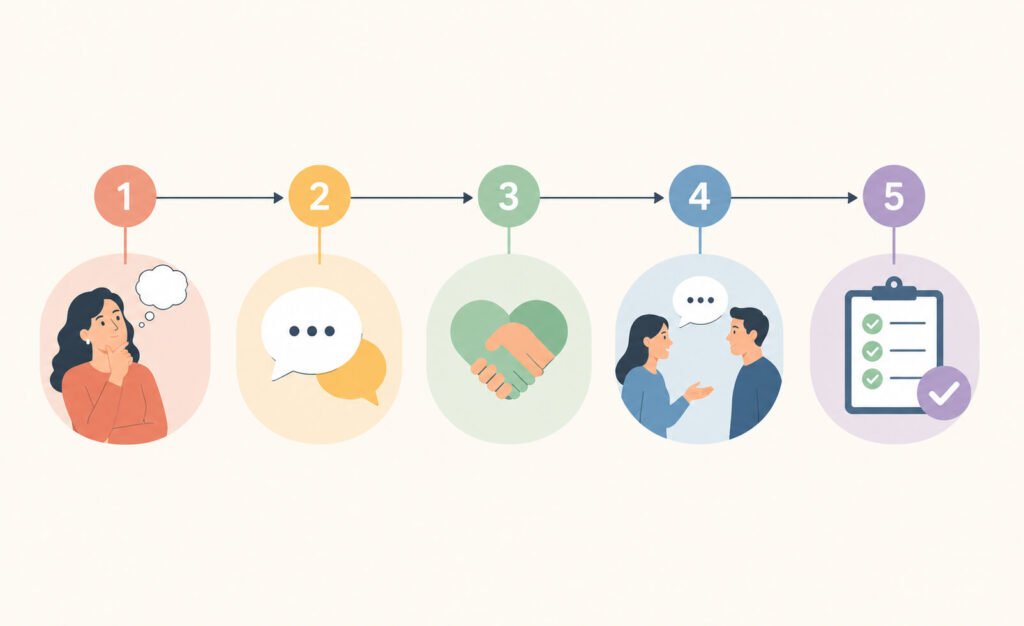
Here’s a straightforward process that makes it a lot more manageable.
Step 1: Get Clear on Your Own Limits First
Before you explain a boundary to someone else, you need actually to understand it yourself.
Ask yourself a few honest questions:
- What behavior makes me genuinely uncomfortable?
- What helps me feel respected?
- What situations leave me emotionally wiped out?
- What do I actually need to feel safe?
The clearer your own answers are, the easier it gets to explain them to your partner.
Step 2: Say It Clearly, Not Vaguely
Nobody can respect a boundary they don’t know exists.
Speak calmly, and be specific.
Don’t expect your partner to just figure it out on their own.
Instead of “you never understand me,” try something closer to “I need some quiet time after work before we get into anything heavy.”
That version focuses on what you need, instead of putting your partner on the defensive.
Step 3: Practice Saying No Without the Guilt Trip
A lot of people were taught that saying no is selfish.
It isn’t.
Saying yes to everything usually leads straight to stress, burnout, and resentment down the line.
A healthy relationship has room for a respectful “no” now and then.
“I appreciate you thinking of me, but I really need tonight to just rest” is honest, kind, and completely clear.
Step 4: Hold the Line Consistently
A boundary only works if it’s consistent.
If you let something slide one day and reject it the next with no explanation, it just creates confusion.
Consistency is really what teaches people how you expect to be treated.
Over time, it stops being a “conversation” and just becomes the normal way things work.
Step 5: Expect a Little Pushback, and Stay Calm Through It
Not everyone adjusts to a new boundary right away.
That doesn’t mean the boundary itself is wrong.
Some people just need time to get used to it.
Stay calm, restate the boundary respectfully if you need to, and try not to let it turn into a full-blown argument every time.
Most people learn through repetition and consistency, not one long explanation.
Boundary Scripts You Can Actually Use
Sometimes the hardest part isn’t knowing you need a boundary, it’s finding the words.
Here are a few real phrases you can adapt to your own situation.
On needing space: “I love you, and I just need thirty minutes alone before we talk about this; then I’ll be fully present.”
On respecting your time: “Saturday mornings are my time with my family; can we plan around that going forward?”
On money: “I’d rather we talk through anything over a certain amount before either of us spends it.”
On privacy: “I keep my phone private; that’s not about hiding anything, it’s just something I need.”
On how you’re spoken to: “I care about working this out, but I’m not going to keep talking while we’re yelling; let’s take a break and come back to it.”
None of these need to be memorized word for word.
The goal is just to get comfortable expressing a need clearly, without turning it into an accusation.
Healthy Boundaries vs. Controlling Behavior in Relationships

A lot of people mix up healthy boundaries with controlling behavior.
They can look similar on the surface, but they’re really not the same thing at all.
A healthy boundary is about protecting yourself.
Controlling behavior is about changing or restricting someone else.
Here’s a quick side-by-side comparison.
| Healthy Boundary | Controlling Behavior |
|---|---|
| Protects your own emotional well-being | Tries to control someone else’s choices |
| Communicated with respect | Uses fear, guilt, or threats |
| Builds trust | Creates fear and anxiety |
| Respects both people | Ignores one partner’s needs entirely |
| Supports independence | Limits freedom and personal growth |
Saying “I won’t stay in a conversation where I’m being yelled at” is a healthy boundary.
Saying “you’re not allowed to talk to your friends” is control, plain and simple.
Healthy boundaries tend to build stronger relationships over time.
Control usually wears them down.
Why People Struggle to Set Boundaries in the First Place
A lot of people already know they need boundaries.
Actually setting them is the hard part.
Here’s why that struggle is so common.
Fear of Rejection
Some people worry that saying no will make their partner love them less.
Genuine love doesn’t disappear because of a respectfully communicated boundary.
If anything, honest communication tends to make a relationship stronger, not weaker.
The Urge to Please Everyone
People-pleasers tend to put everyone else’s comfort ahead of their own, almost automatically.
Over time, that pattern leads straight to emotional burnout.
Taking care of yourself, in the long run, actually makes you a better partner too.
Growing Up Without Good Examples
Some people grew up in homes where boundaries just weren’t a thing.
Because of that, spotting unhealthy patterns as an adult doesn’t always come naturally.
The reassuring part is that healthy relationship habits can be learned at any age; it’s never too late to start.
Feeling Like Boundaries Are Selfish
A lot of people assume setting a boundary is a selfish move.
It isn’t.
Boundaries protect your mental and emotional health while, at the same time, making the relationship healthier for both people.
What Happens When Boundaries Get Ignored
Ignoring a boundary rarely makes a relationship better.
Instead, small issues tend to snowball into much bigger ones.
Some common results include:
- Frequent misunderstandings
- Constant arguments
- Emotional exhaustion
- Loss of trust
- Growing resentment
- Anxiety
- Feeling unappreciated
- General relationship dissatisfaction
Picture telling your partner, more than once, that you need uninterrupted time while working from home.
If they keep interrupting anyway, the frustration builds naturally, and understandably.
Eventually, it stops being about the interruptions themselves.
It becomes about feeling unheard.
That’s exactly why respecting a stated boundary matters so much.
How to Respect Your Partner’s Boundaries Too
Respect runs both directions.
If you want your own boundaries honored, you have to honor your partner’s too.
Here are a few simple ways to actually do that.
Listen Without Getting Defensive
If your partner brings up a boundary, try not to take it personally right away.
Instead, aim to understand why it actually matters to them.
Listening with genuine empathy is what builds trust over time.
Ask Questions When You’re Not Sure
If a boundary isn’t totally clear to you, just ask.
“What would make you feel more comfortable here?” is a simple, respectful way to find out.
A little curiosity prevents a lot of unnecessary misunderstandings.
Resist the Urge to Test It
Some people push against a boundary just to see if the other person is serious.
That habit chips away at trust fast.
A healthy relationship respects a boundary instead of quietly testing it.
Actively Support Their Growth
Healthy couples encourage each other’s friendships, hobbies, careers, and personal goals, even the ones that don’t involve them directly.
Real love creates room to grow, not restrictions that hold someone back.
Common Mistakes People Make When Setting Boundaries in Relationships
Even with good intentions, this is easy to get wrong.
Here are a few of the most common slip-ups.
Waiting Too Long to Speak Up
A lot of people stay quiet for months before saying anything.
By that point, frustration has already built up under the surface.
It’s almost always easier to say something early, before resentment has a chance to take root.
Being Inconsistent About It
If a boundary keeps shifting with no real explanation, it just confuses everyone involved.
Consistency is what helps your partner actually understand what you expect.
Expecting Them to Just Know
Your partner can’t read your mind, no matter how long you’ve been together.
Clear communication will always work better than hoping they figure it out on their own.
Turning a Boundary Into a Punishment
A real boundary protects your well-being.
It was never meant to be a tool for manipulating someone.
Going silent for days to “teach a lesson” isn’t a boundary; it’s unhealthy communication wearing a disguise.
Forgetting Your Partner Has Boundaries Too
A healthy relationship runs on mutual respect.
Your needs matter, and so do theirs, equally.
Frequently Asked Questions
What are healthy boundaries in a relationship?
Healthy boundaries are clear limits that protect your emotional, physical, mental, and personal well-being.
They help both partners understand what’s okay while building trust, respect, and healthy communication.
Healthy boundaries are never about controlling another person; they’re about expressing your own needs respectfully.
How do you set boundaries in relationships without starting a fight?
Pick a calm moment, not the middle of an argument.
Use respectful, direct language.
Focus on your own feelings rather than putting blame on your partner.
Something like “I need some quiet time after work before we get into anything heavy” tends to open a conversation rather than close it down.
What do unhealthy boundaries actually look like?
A few common examples: tolerating disrespect, constantly putting your own needs last, accepting manipulation, feeling guilty every time you say no, or having basically no personal space of your own.
Patterns like these usually build resentment and emotional exhaustion over time.
Is it selfish to set boundaries in relationships?
No, not at all.
A healthy boundary is really a form of self-respect.
It protects your emotional well-being while making the relationship stronger for both people involved.
A relationship where both people can be honest about their needs tends to hold up a lot better than one where everything gets swallowed and hidden.
Can setting healthy boundaries actually build more trust?
Yes, genuinely.
Trust grows when both partners consistently respect each other’s limits.
Knowing your needs will actually be heard and honored creates real emotional safety.
That safety is what lets love grow naturally, instead of under constant pressure.
What should I do if my partner keeps ignoring my boundaries?
Start by calmly restating the boundary you already discussed.
Explain why it matters and how ignoring it affects you.
If your partner keeps ignoring a clearly communicated boundary with no real effort to change, it’s worth honestly evaluating whether the relationship is actually meeting your needs.
A healthy relationship needs real effort from both people, not just one.
Conclusion
Learning how to set healthy boundaries in relationships is genuinely one of the best things you can do for yourself and for your partner.
Boundaries were never about creating distance.
They’re about creating respect.
They let both people feel heard, valued, and emotionally safe, day to day.
This is a skill, and like any skill, it gets easier the more you practice it.
Start with one small boundary today.
Say it kindly.
Stay consistent about it.
And respect your partner’s boundaries just as much as you’d want them to respect yours.
Over time, these small, repeated changes add up to better communication, deeper trust, more emotional safety, and a relationship where both people actually have room to grow.
A healthy relationship isn’t built by dodging hard conversations.
It’s built by having them, with honesty, kindness, and mutual respect leading the way.
Keep Building a Healthier Relationship
Setting healthy boundaries is an important part of creating a relationship built on trust, respect, and understanding.
If you want to learn more about what makes a strong relationship work over time, explore What Makes a Relationship Last?
You can also discover the everyday behaviors that can help couples build trust, communicate better, and feel more connected in 10 Signs of a Healthy Relationship.